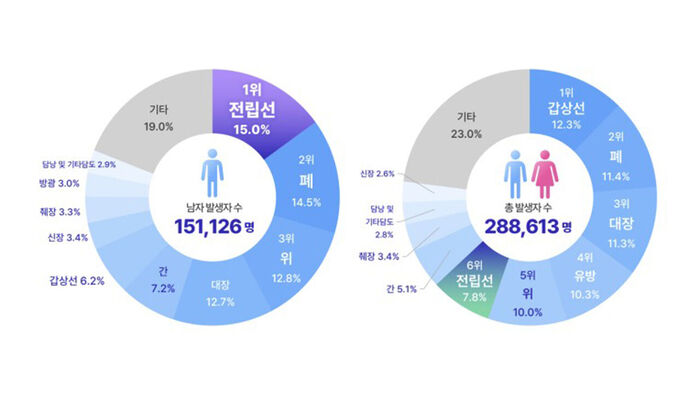
▲ Prostate cancer has become the most common cancer among men.
Prostate cancer has surpassed lung and stomach cancer to become the most frequently diagnosed cancer among men in South Korea.
According to statistics recently released by the Korean Urological Oncology Society, the number of new prostate cancer patients in the country reached approximately 23,000 in 2023.
This figure represents a 2.2-fold increase compared to just 10 years ago.
Accounting for 15% of all male cancer patients, it has overtaken both lung and stomach cancer, which had previously held the top spots.
A key characteristic of prostate cancer is that its incidence rate rises sharply with age.
The upward trend becomes evident starting in the 50s, with a rapid surge in patients among the elderly population aged 60 and older.
The biggest problem is that there are almost no symptoms in the early stages, making it easy for the disease to progress undetected.
However, if detected in the early stages while the cancer is still confined to the prostate, the five-year survival rate exceeds 95%.
Ultimately, how quickly the disease is detected when there are no symptoms is the key factor that determines the prognosis.
Currently, the most practical method for early detection is the Prostate-Specific Antigen (PSA) test, which involves a blood draw.
A point of concern is that this test is still excluded from the national cancer screening program.
Because individuals must feel the need and pay for the test out-of-pocket, diagnostic opportunities vary depending on income levels.
An analysis of the actual statistics revealed that the crude incidence rate of prostate cancer among the highest-income group was seven times higher than that of the lowest-income group.
Professor Lee Seung-hwan of the Department of Urology at Severance Hospital pointed out, "The survival rate and quality of life for prostate cancer patients vary significantly depending on whether it is detected early."
He added, "Discussions on national-level early screening should no longer be delayed."
The risk factors for the disease in daily life are also relatively clear.
The incidence rate was higher in men with metabolic diseases such as diabetes or hypertension, as well as those with abdominal obesity or a lack of exercise.
In particular, long-term smokers who have smoked for more than 30 years showed a 5.3 times higher incidence rate compared to those who started smoking recently.
Jung Byung-chang, president of the Korean Urological Oncology Society, explained, "Regular checkups during the asymptomatic stage determine the success or failure of early detection and treatment."
He further urged, "Policy support is needed so that citizens can receive screenings regardless of their economic circumstances."
(Photo: Provided by the Korean Urological Oncology Society, Yonhap News)
※ Please note: This article was translated by AI and may contain errors.